The Holy Spirit: A Gift That Cannot Be Bought
Acts 8:9–25
SERMON • This message tells the story of Simon the magician, a man captivated by spiritual power but blind to the condition of his own heart. The gospel exposes false religion, addresses the heart, and reminds us that the Holy Spirit is not a power to control but a Gift of grace to receive. Are we trying to use God or humbly surrender to Him?
Introduction
About 70% of people who live in Southwest Ohio identify as "Christian" of some sort. But there are lots of reasons and motivations for being religious, right? Often, beneath our stated reasons, there are deeper cravings at work in our hearts. We may desire to feel significant, or want love and approval; we may want our pain noticed, or we may crave to feel powerful, insulated from a dangerous and unstable world.
Quite often, our heart motives are fickle and mixed. As the prophet Jeremiah lamented, "The heart is deceitful above all things, and desperately sick; who can understand it?" (Jer. 17:9)
So, I'll ask you: "What brings you in today? What are you seeking?"
Our passage today, Acts 8:9-25, addresses a universal spiritual danger: We are prone to seek blessings from God while our hearts remain mixed with selfish ambition, pride, and the desire to control things around us, including God.
I don't often do this, but I'm going to begin my sermon with the punchline, then show how the story in our text unpacks it. Here's the main idea:
Because the power of God's Holy Spirit is a gracious gift that cannot be bought or manipulated, we must repent of selfish ambition and seek a heart that is truly humble, submitted, and right before God.
Context: The Gospel Reaches Samaria
Acts chapter 8 marks a turning point in the book. In Acts 1:8, Jesus gave the programmatic outline for the whole book, and the mission of the church:
"You will be my witnesses in Jerusalem and in all Judea and Samaria, and to the end of the earth" (Acts 1:8).
In the early chapters of Acts, the gospel spread throughout Jerusalem. But Acts 8 begins the second stage of that expansion; the gospel moves into Samaria.
Philip traveled north into Samaria, a region long marked by hostility between Jews and Samaritans. For centuries, these two groups generally despised one another. Jews regarded Samaritans as compromised, religious "mutts," both socially and religiously. There was a deeply entrenched mutual hostility, a socio-religious separation between these two people groups.
But then Philip arrives in Samaria preaching what Luke calls "the good news about the kingdom of God and the name of Jesus Christ." God's kingdom is breaking into the kingdoms of earth that bring about spiritual and social bondage.
From one vantage, the good news of the Christian gospel is all about God's saving project to reclaim his fallen creation as our Savior-King. As theologian Graham Cole puts it, "The grand project is realized when God's people are in God's place under God's rule, living God's way in God's holy and loving presence as family." Graham Cole, He Who Gives Life: The Doctrine of the Holy Spirit (p. 116).
Our text is a story about a dramatic collision between false spiritual power and the true power of God. And in that collision, the deeper issues of the human heart are laid bare.
We'll see four movements in this story: False Power Impresses the Crowds. Gospel Power Transforms the Heart. Rebel Hearts Try to Control God. Repentant Hearts Receive Grace.
1. False Power Impresses the Crowds (vv. 8:9-11)
"9 But there was a man named Simon, who had previously practiced magic in the city and amazed the people of Samaria, saying that he himself was somebody great. 10 They all paid attention to him, from the least to the greatest, saying, 'This man is the power of God that is called Great.' 11 And they paid attention to him because for a long time he had amazed them with his magic." (vv. 9-11)
Philip came to Samaria to preach about God's kingdom and King Jesus. But Samaria already had a spiritual celebrity. Before Philip had arrived, a man named Simon had captivated the region. Luke says Simon had "practiced magic in the city and amazed the people of Samaria."
Magic was widespread throughout the Greco-Roman world. Magicians claimed to manipulate spiritual forces through rituals, spells, incantations, and secret knowledge.
Simon had achieved status. He had influence. He had admiration. He had a following. But then the gospel came to town.
The word Luke uses for "magic" indicates sorcery. Simon was a practitioner of occult arts, someone who had built his reputation on the claim that he could manipulate supernatural forces. His magic was most likely not fake but a demonic power wielded for self-exaltation.
Impressive Power Is Not Divine Power
Humans have always been fascinated with displays of power. When something appears supernatural or spectacular, we're naturally drawn to it. According to a 2025 report by Pew Research, some 30% of Americans admit to dabbling in the occult and New Age practices at least once a year, consulting astrology, tarot cards, or fortune tellers.
But Scripture consistently warns that impressive power is not the same thing as divine power.
In Deuteronomy 13:1-3, God warned Israel that even if a prophet produced signs and wonders, the people must still test the message against the truth of God's word. Jesus warned in Matthew 24:24 that false christs and false prophets would arise and perform great signs and wonders, deceiving many. Paul, too, writes in 2 Thessalonians 2:9-10 that the coming of the Antichrist will be accompanied by "all power and false signs and wonders."
This means that paranormal activity, or even signs and wonders, are not in themselves proof of divine activity at all.
Test Every Voice by Scripture
The Samaritans' vulnerability to Simon's sorcery is a cautionary note to us in several ways.
First, we should prayerfully test all claims by Scripture rather than impressiveness or popularity. Just because a person is persuasive, influential, or even spiritual does not mean he speaks for God.
Maybe a Ouija board isn't your thing, but do we practice spiritual discernment when we hear Jordan Peterson, Joe Rogan, or Joyce Myers, or your podcasts of choice on life "wisdom," parenting advice, or whatever? The point isn't that they are all the same, but that we must test every voice by Scripture, not by eloquence, influence, or plausible-sounding counsel.
Second, we parents must teach our children to be discerning about spiritual and practical ideologies they'll encounter online, on TV, at school, and in society at large. "Heads in the sand" usually end up on the tip of a cultural spear. We must prepare our kids for life.
False religion may impress the crowds. But it cannot transform the heart. And that brings us to the next movement in our story.
2. Gospel Power Transforms the Heart (vv. 8:12-17)
"12 But when they believed Philip as he preached good news about the kingdom of God and the name of Jesus Christ, they were baptized, both men and women. 13 Even Simon himself believed, and after being baptized, he continued with Philip. And seeing signs and great miracles performed, he was amazed.
14 Now when the apostles at Jerusalem heard that Samaria had received the word of God, they sent to them Peter and John, 15 who came down and prayed for them that they might receive the Holy Spirit, 16 for he had not yet fallen on any of them, but they had only been baptized in the name of the Lord Jesus. 17 Then they laid their hands on them, and they received the Holy Spirit." (vv. 12-17)
In contrast to Simon, Philip's message was not about himself. It was about Jesus. He proclaimed "the kingdom of God and the name of Jesus Christ." Philip's central message was that Jesus is the crucified and risen King who saves and transforms sinners and brings them under the present reign of God.
Luke says the people believed. They were baptized. A new community of faith emerged in Samaria.
Why Was the Spirit Delayed?
From vv. 14-16, we may wonder why Luke tells us there was a delay in the new believers receiving the Spirit in Samaria. Typically, in Acts, people "received the Spirit" at the time of their conversion.
The Samaritans appear to have truly trusted in Christ and had been saved, and yet there was a delay in the visible reception of the Spirit. Theologians have offered at least three reasons for this delay.
First, God seems to have withheld a public manifestation of his Spirit so that the apostles from Jerusalem, Peter and John, could witness and confirm the Samaritans' inclusion into the church God had established first in Jerusalem. This would have authenticated the Samaritans' salvation for the Christians back in Jerusalem.
Second, this would preserve church unity and prevent a potential schism or split between the Samaritan church and the Jerusalem church. There was already a stark social divide. The apostles' presence there would keep Samaritan and Jewish churches from developing into separate Christian movements.
Third, this falling of the Spirit on the Samaritans was a hugely significant salvation-historical event. It signified that a crucial frontier had been crossed in the fulfillment of Acts 1:8; and it showed that hated "outsiders" who trust in Jesus are just as fully incorporated into the apostolic, Spirit-filled people of God as any Jew was.
And so the Spirit timed things to signify that the work was a true work of God.
God was doing a spectacular work in Samaria in ways that changed hearts and empowered the witness of the church in mighty ways.
The Spirit Still Changes Hearts
I wonder, are you convinced that the Holy Spirit changes hearts today? Do you believe the testimony of Scripture that he heals lives and breaks down walls of hostility? Have you experienced this personally, relationally?
Some of us here may have relationships right now that are hostile and seem utterly hopeless. But with God, all things are possible. Where we can't, God can. God is in the heart-transforming business through the gospel of a bloody cross, an empty tomb, and an occupied throne.
The Spirit was working in Samaria, and Simon was watching. In fact, Philip and the apostles' miracles excited something evil in his heart.
3. Rebel Hearts Try to Control God (vv. 8:18-21)
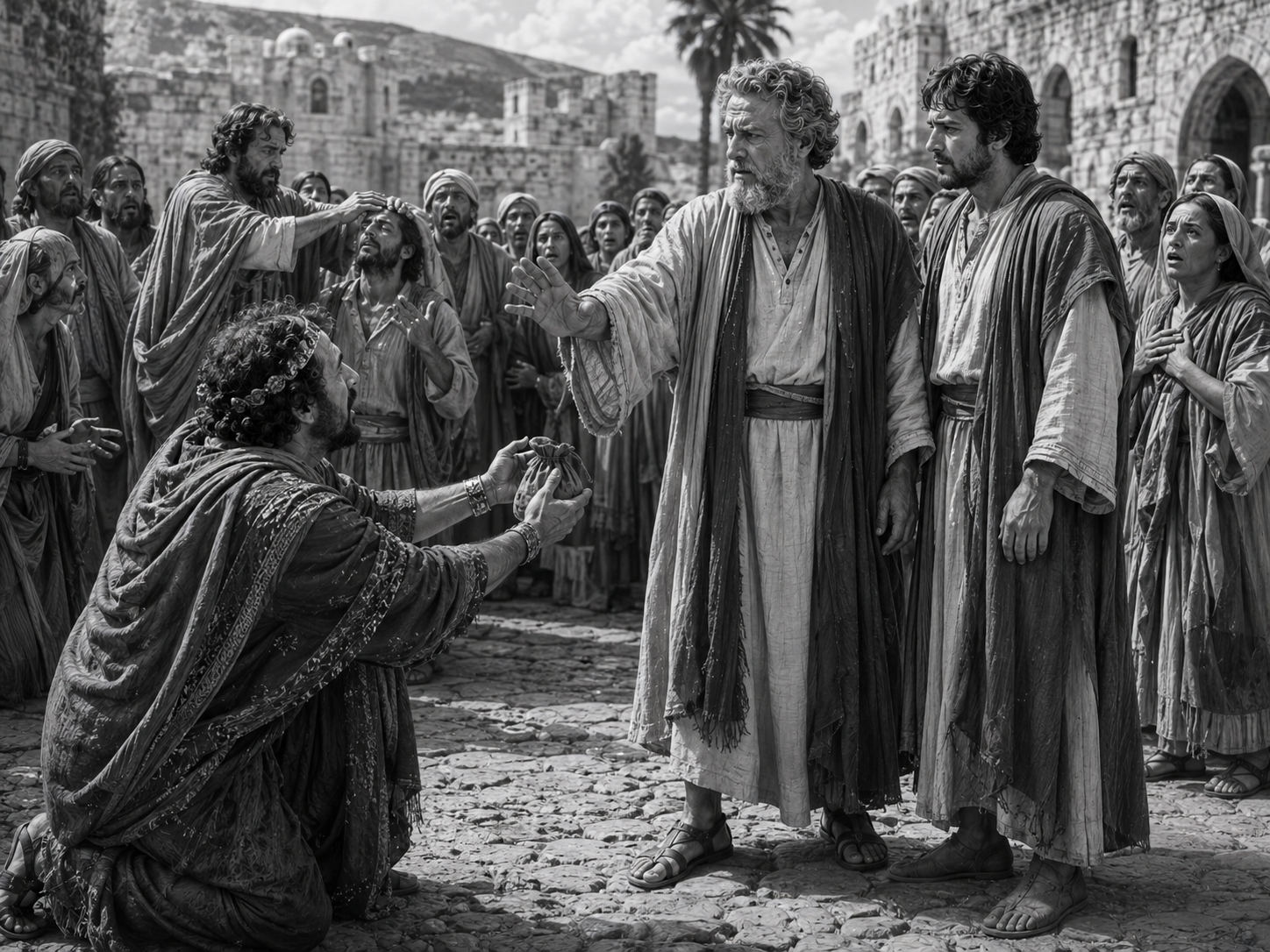
"18 Now when Simon saw that the Spirit was given through the laying on of the apostles' hands, he offered them money, 19 saying, 'Give me this power also, so that anyone on whom I lay my hands may receive the Holy Spirit.' 20 But Peter said to him, 'May your silver perish with you, because you thought you could obtain the gift of God with money! 21 You have neither part nor lot in this matter, for your heart is not right before God.'" (vv. 18-21)
Luke brings us to the turning point in the story. Simon had watched all these events unfold. He saw Philip perform miracles. He saw the apostles pray and the Holy Spirit given. And immediately, he interpreted the situation through the framework of his life as a magician.
In the world of magic, influence could be gained through miraculous signs, and Simon wanted in! So, he approached the apostles and offered them money to buy the power of God.
Despite his profession of faith and baptism, his request revealed the true condition of his heart. He didn't want the Spirit for personal growth in godliness. He didn't desire Jesus to be his sovereign Lord and King. He didn't seek God's glory. He wanted the Spirit's power for personal influence. He thought he could channel God's Spirit like he had channeled evil spirits!
Transactional Faith
Now, we, of course, look down on his naive self-centeredness with scorn, but don't we do the same thing in other ways? How often do we scurry around doing things for God, and in the back of our minds, we're hoping he'll return the favor? How often do we pray for God's power and blessing, not from pure hearts passionate for God's glory, but from hearts passionate for our own comfort, pleasure, and significance?
In our lesser moments, we quickly turn our faith into a quid pro quo, transactional arrangement with God: "I'll scratch your back, God, if you scratch mine."
But it doesn't work. It never works. God won't play that game. And after a while, we get discouraged and disillusioned; we get angry, even bitter, because we've played the music, but Jesus hasn't danced for us.
Like the prophets of Baal, we leap and whine and injure ourselves, doing everything we can to manipulate God into doing our will in heaven and earth. And in response to our pride, God shuts up the heavens and withholds the rains of his blessing, fellowship, and power.
The silence of heaven can be deafening. Maybe you've heard it. "Where is God anyway?" "Why didn't he do what I asked him to do?" "Why is he blessing others in this or that way and not me?" "I'm doing all these good things, God! What gives?!"
But in God's mercy, he lets us wallow long enough in our self-pity to realize that we're the ones sitting on the throne of our lives calling the shots, not him. We've crowned ourselves "kings," and we've made him our subject, or so we think.
When Our Desires Rule Us
The epistle of James levels this accusation against highly religious people, in James 4:
"1 What causes quarrels and what causes fights among you? Is it not this, that your passions are at war within you? 2 You desire and do not have, so you murder. You covet and cannot obtain, so you fight and quarrel. You do not have, because you do not ask. 3 You ask and do not receive, because you ask wrongly, to spend it on your passions. 4 You adulterous people! . . . 6 But he gives more grace. Therefore, it says, 'God opposes the proud but gives grace to the humble.'" (James 4:1-4, 6)
What could be more terrifying than being opposed by God? He opposes us in our spiritual adultery. He won't pay the hotel bills for our hearts' liaisons with our idols. He resists all prayers that are thinly veiled attempts to get from him what we sometimes most deeply care about his stuff, his power, his blessing, and not him.
Remarkably, we can even do this with the Holy Spirit. We want the thrill of the Spirit's presence, ecstatic experiences, power over demons, but are we even more joyful knowing our names are written in heaven, as Jesus told us to be? (Luke 10:20)
We want the Spirit's instant cures for our sicknesses, sorrows, and troubles, but will we trust God when he says "no," as he did of Paul's thorn in the flesh? (2 Cor. 12:7-9)
We want the Spirit's blessings on our families, our work, our education, but is our chief boast not in being made healthy, wealthy, and wise but in knowing the Lord as our all-surpassing treasure, as God through the prophet Jeremiah urged us? (Jer. 9:23-24)
Even as we pray for more of the Spirit, have we learned to be content with his sustaining grace along a painful path he's chosen for us that we wouldn't have chosen for ourselves?
Here's the bottom line: Is Jesus our King, or our vending machine?
We will see the power of God at work in us and through us to the same degree that Jesus is King over us, and no more. In our worst moments, we're more like Simon than we care to admit. But the story doesn't end there, praise God.
4. Repentant Hearts Receive Grace (vv. 8:22-25)
"22 Repent, therefore, of this wickedness of yours, and pray to the Lord that, if possible, the intent of your heart may be forgiven you. 23 For I see that you are in the gall of bitterness and in the bond of iniquity.' 24 And Simon answered, 'Pray for me to the Lord, that nothing of what you have said may come upon me.' 25 Now when they had testified and spoken the word of the Lord, they returned to Jerusalem, preaching the gospel to many villages of the Samaritans." (vv. 22-25)
Externally, Simon had appeared to believe the gospel like the others. He was even baptized and began to follow Philip! But Peter, who had discerned Ananias and Sapphira's hypocritical hearts in chapter five, discerns the selfish motive behind Simon's request.
But even in Peter's stern rebuke, there's hope for Simon: "Repent, therefore, of this wickedness of yours . . . that the intent of your heart may be forgiven you." And notice that Peter doesn't just rebuke Simon; he exposes his heart. He looks him in the eye and says, "I see that you are in the gall of bitterness and in the bond of iniquity." Simon was just as enslaved to his sinful pride and hunger for power and praise as before.
The Sin Beneath the Sin
But what's even more amazing is that Peter pinpoints the sin beneath the sin. There was a dynamic in Simon's heart viciously at work, feeding his hunger for power.
It was bitterness. Bitterness! Paul lamented in Philippians 1:16-17,
"Some indeed preach Christ from envy and rivalry . . ., out of selfish ambition, not sincerely but thinking to afflict me in my imprisonment." (Philippians 1:16-17)
What? We can preach Christ, motivated not by love but envy? What? We can disciple our kids diligently from a heart of rivalry? What? We can seek the power of the Holy Spirit out of selfish ambition?
No wonder John Calvin called the human heart a "factory of idols." And no wonder Martin Luther envisioned "the entire life of believers to be one of repentance." There's not a moment that goes by, 24/7/365, when sin is not crouching at the door of our hearts, tempting us to replace Christ with a false king in a single moment. This shouldn't drive us to be paranoid or morbidly introspective. No, it should drive us daily, hourly, to Christ, the only one who breaks bondage to iniquity and sets captives free to serve God from pure hearts!
The Real Problem Is the Heart
Notice, Peter doesn't tell Simon, "Man, you've got daddy issues, and you need therapy and to work on yourself."
That's puny advice. That's humanistic advice. That's godless advice. That's advice void of the gospel. That's advice that treats the symptoms and ignores the cancerous sin lurking in the heart. No, he describes his enslaving hunger for admiration and influence as a heart "not right with God," vertically, a heart soaking in the "gall of bitterness," a heart steeped in a putrid poison spreading like infection in his life.
I can't help but wonder whom Simon had bitterness against. Had his mom or dad acted as if, or even told him, that he'd never amount to anything? Did this drive him to pursue power at all costs to prove them wrong? Had a trusted friend betrayed and undermined him? Had a woman rejected his offers of love? Had peers mocked him, doubted him? Did he feel like he was living in someone else's shadow?
We don't know, and ultimately, it didn't matter what the "triggering event or events" were for Simon, or for you and me. That's the wrong question. The cancer wasn't his broken childhood. It wasn't lost love, or a host of other possibilities. The cancer was his fallen heart and how he'd sinfully responded to whatever had happened to him. Peter says he was eaten alive by bitterness. He'd bought into the lie that he could prove himself by becoming someone powerful, successful, admired, someone significant.
Who Are You Trying to Prove Wrong?
Can I ask you a personal question? When I was just describing possible people and events in Simon's life against whom he may have been bitter, did someone or some event in your life come to mind? Who are you trying to prove wrong? Who are those people for you? What were those events for you? The cancer isn't those people or those events. It's the idols you and I have erected against them in the place of God himself.
The gloriously freeing news of Philip's gospel is that the gift of God's powerful, healing, bond-breaking Holy Spirit can't be bought by any amount of our money, blood, sweat, or tears.
And there are two reasons for this: first, we can't afford the Holy Spirit or his blessings; he's out of our price range; second, he's already been bought and paid for by the precious blood of Jesus Christ!
Christ Has Already Paid the Price
The same Peter who saw through Simon's bitter pursuit of the Spirit's power would later write, in 1 Peter 1:18-19:
"You were ransomed... not with perishable things such as silver or gold, but with the precious blood of Christ" (1 Peter 1:18-19).
Jesus on the cross has bought the rights to our lives, our destiny, and the Spirit's power when he suffered the wrath of God against the evil intents of hearts not right with God.
He purchased our freedom from the penalty of our past sins. He purchased our freedom from the power of idols over our present lives. He purchased our freedom from the very presence of sin in the future.
Conclusion
We can't barter or buy this work of God. We can't manipulate it with religious performance or spiritual technique. We can't purchase the significance, security, or success we think we so desperately need to prove ourselves. But Jesus offers his Spirit freely to all who turn from dead idols and surrender in faith to the true King Philip proclaimed to the Samaritans so long ago.
Will you bow your heart to King Jesus today? ❖