Triumphs and Tribulations Along the King’s Highway
Acts 14:1–28
SERMON • Acts 14 follows Paul and Barnabas through gospel success, temptation, near death by stoning, and the growth of new churches. Along the way, the chapter shows us: faithfulness is not measured by ease; success belongs to God; and suffering does not mean God is against us. The King’s highway on which the Christian travels is difficult, but grace keeps leading home through every triumph and tribulation.
Introduction
In 1678, John Bunyan published The Pilgrim’s Progress, a book on the Christian life that he wrote while in prison for preaching the gospel.
The main character in the book, Christian, leaves his hometown, the City of Destruction, and travels toward the Celestial City.
But Bunyan describes this road—which he calls “the King’s Highway”—as a path filled with both unexpected joys and hardships.
Along the King’s Highway, Christian must climb the Hill of Difficulty. Later, he must pass between two chained but menacing lions. He must descend into the Valley of Humiliation, where he fights Apollyon, the great adversary of the Lord’s people. He walks through the Valley of the Shadow of Death, through darkness, snares, pits, and terrors. He walks through dazzling Vanity Fair, where his dear traveling companion, Faithful, is martyred for his gospel witness.
Bunyan’s conception of the Christian life is hard for us to accept, but it’s honest and biblical.
Do you ever find yourself assuming that if you’re following Jesus, the road should always be flat, sunny, and easy? Marriage should be easy. Parenting, easy? Work, easy? Health, easy? Friendships, sharing the gospel, Mission Group, easy? When the King’s Highway grows difficult, reality shatters our expectations of ease, and we wonder:
“Have I taken a wrong turn?”
“Is God against me?””
“Is it all worth it?”
Acts 14 takes us down the King’s Highway with Paul and Barnabas.
They see pagans turn to Christ for salvation; they see miracles, successes, and the gospel spread. But they also face unfair slander, rejection, threats, temptations, and violence.
Yet along the way, Paul and Barnabas do not conclude at any point that they must have taken a wrong turn somewhere, or that God is against them. They exhibit a mature kingdom perspective that each of us must learn:
Trials and tribulations hurt but are to be expected along the path of obedience. The road into the Kingdom of God is a rewarding yet embattled one.
The Context of Acts 14
Acts 14 drops us back into Paul’s first missionary journey, recorded in Acts 13–14.
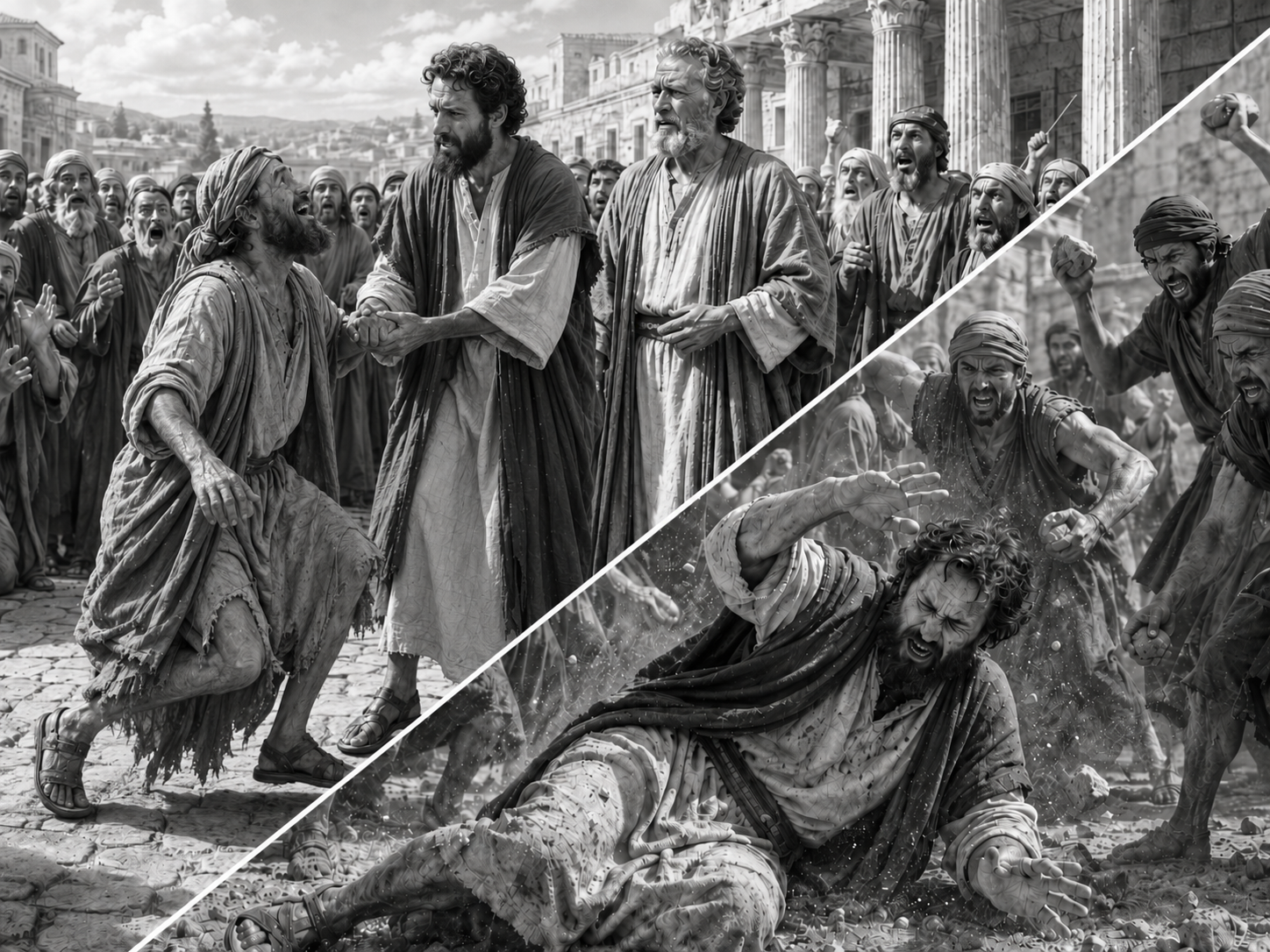
Being sent by the church of Antioch in Syria, Paul and Barnabas cross Cyprus and enter modern-day Turkey, carrying the gospel through Pisidia, Iconium, Lystra, and Derbe. These four cities stood along important trade routes and differed in language, religion, and culture. These are not safe, welcoming territories. Paul and Barnabas are threatened in Iconium, mistaken for gods in superstitious Lystra, and then Paul is stoned and left for dead.
By the end of the chapter, they’ve returned full circle to Antioch and report, in v. 27, “all that God had done with them” and how he had “opened a door of faith to the Gentiles.”
As we trace their steps and see their responses to the triumphs and tribulations they encounter, I want to take the approach of gleaning four insights that should inform our own pilgrimages along the King’s Highway in our own lives.
In vv. 1–7, we see, first, that they:
1. Pursue Faithfulness, Not Ease (vv. 1–7)
Paul and Barnabas enter Iconium and preach, as v. 1 says, “in such a way that a great number of both Jews and Greeks believed.” Gospel fruit is being born, but so is resistance to the gospel. In v. 2 we read that “The unbelieving Jews stirred up the Gentiles and poisoned their minds against the brothers.” Notice, Luke places conversions and conflict side by side. Faithfulness does not bring ease; it often intensifies opposition.
Verse 3 reveals the missionaries’ strong sense of calling: “So they remained for a long time, speaking boldly for the Lord.” They do not interpret human hostility as proof that God was against them. They instead remain faithful to Christ’s calling on their lives.
In v. 7, when the threat becomes an organized attempt to kill them, they flee to Lystra and Derbe: “There they continued to preach the gospel.” So, whether staying or moving on to the next opportunity, whether welcomed or rejected, they seem to be focused on one question: “What does faithfulness to Christ require of us now?”
They pursue faithfulness, not ease.
The Example of William Carey
In 1812, a fire swept through the Serampore Mission Press in India, where “the father of modern Protestant missions,” William Carey, had spent years translating, printing, and distributing Christian literature in India. The flames consumed years of manuscripts, dictionaries, grammar works, and the typesets handcrafted to print in several languages. The loss was devastating.
As Carey walked through the smoking ruins and charred equipment with his friend, Thomas Thomason, tears filled his eyes, and he reportedly said: “The Lord has laid me low, that I may look more simply to Him.”
If it were me, it would’ve been easy to interpret this tragedy as divine abandonment or even punishment, and even more tempting to see it as permission to abandon his work and return home to England. But Carey began rebuilding what had been lost, and eventually the press resumed printing gospel literature. Carey embodied trust in God’s promise in Psalm 34:19:
“Many are the afflictions of the righteous, but the Lord delivers him out of them all.”
Paul and Barnabas embraced this same perspective that sometimes obedience means loss and rebuilding. But it never means making comfort the measure of God’s presence, power, or goodness.
Faithfulness or Ease?
When we think about our own lives, do we measure “the good life” by faithfulness to Christ or by ease? We’re often tempted to decide whether we are doing the right thing based on how easy it feels. But comfort is a broken compass that rarely points us deeper into the kingdom of God. I wonder what tribulations you’re facing right now. A strained relationship? A difficult decision? A heavy responsibility? A hard conversation you need to have?
Will you pursue faithfulness to Jesus, or ease?
Faithfulness is a wonderful two-edged sword. It keeps us from retreating when the road is hard. But it also guards us from pride when the path enters a sunny, broad, and beautiful clearing, and we feel the thrill of success. In vv. 8–18, we see Paul and Barnabas’s kingdom-minded response to success, and we learn, secondly, to
2. Let Success Magnify God, Not Pride (vv. 8–18)
Verse 8 brings us to the city of Lystra, where Paul encounters a man “crippled from birth,” a man who “had never walked.” Paul looks intently at him, discerns that he has faith to be made well, and commands, “Stand upright on your feet.” Immediately, the man springs up and begins walking.
But the crowds interpret this miracle wrongly. They begin shouting in their Lycaonian language, “The gods have come down to us in the likeness of men!” In their amazement and religious superstition, they begin calling Barnabas the incarnation of Zeus and Paul, Hermes, Luke records, since Hermes was the Greek messenger god, and Paul was the main speaker.
As awkward as this must have been, it gets even worse! Pagan priests bring oxen and flowers, ready to offer sacrifices to these missionaries of Christ! Talk about the rollercoaster of ministry and the Christian life!
Where threats must have tempted them to despair in Iconium, success and god-level popularity now test their pride in Lystra. But rather than relishing their newfound status and telling each other they’ll correct the bad theology later, we see them responding quite differently in vv. 14–15, 18:
“14 But when the apostles Barnabas and Paul heard of it, they tore their garments and rushed out into the crowd, crying out, 15 ‘Men, why are you doing these things? We also are men, of like nature with you, and we bring you good news, that you should turn from these vain things to a living God, who made the heaven and the earth and the sea and all that is in them…. 18 Even with these words they scarcely restrained the people from offering sacrifice to them.”
Paul and Barnabas, no doubt, rejoiced in God’s miraculous power at work through them, but they understood the source of their success was God and not their own power or ingenuity.
Success is never meant to be a mirror in which to admire ourselves but a window through which all may behold the glory of God, the Giver of every good gift.
The Stained Glass Window
I love stained glass windows. But in the dark, a stained glass window is dim and ordinary. Then as sunlight breaks over the horizon and pours through it, the window begins to glow with vibrant beauty. People may stop and admire the window. They may marvel at its craftsmanship. But the window creates none of the light that is being refracted. Take away the sun, and the beauty disappears.
That’s how it is with us. God often gives many remarkable gifts in the church for the joy and building up of his people, the pushing back of the kingdom of Satan, and the salvation of the lost. He uses our words, our generosity, our parenting, our worship, our wise counsel, our hard work as volunteers, and more. And others may genuinely see something beautiful and powerful through our lives. But the light does not originate in us. Pride grows when the window fancies itself the sun.
We see Paul and Barnabas refusing that confusion. The crowd saw divine power and tried to worship the human instruments. So, they tear their clothes and give all glory to God because they know how deadly pride is to us all.
When Success Comes
How should we respond when we experience successes in life, applause or admiration in the workplace, or in the church, or among our peers?
We must redirect all praise and glory to God. When someone praises or compliments you, receive it as encouragement from the Lord, but receive it humbly. Let gratitude turn it into an occasion for our own hearts to admire the Lord for the good He’s accomplishing through us. Simply brushing it off might feel humble, but it misses the opportunity for proper worship to happen. To paraphrase what a missionary said long ago:
“The Lord might use us more mightily if He could trust us not to steal his glory.”
Paul and Barnabas didn’t let success go to their heads, which was fortunate, because the same crowd that worshiped them would soon turn on them and begin lobbing stones at their heads. Next, we learn from them, thirdly, in vv. 19–23 to
3. See Tribulation as a Path Deeper into the Kingdom (vv. 19–23)
As is often the case in life, circumstances can change with terrifying speed. Verse 19 narrates,
“But Jews came from Antioch and Iconium, and having persuaded the crowds, they stoned Paul and dragged him out of the city, supposing that he was dead.”
The same idolatrous crowd that wanted to sacrifice to Paul is just as easily persuaded to sacrifice Paul. They stone him, drag him outside the city, and leave him for dead. Remarkably, Paul eventually wakes up, likely with a concussion that would make a rugby team blush, and reenters the city of Lystra. And the very next day, he travels to Derbe and continues preaching the gospel and making many disciples of Jesus.
Verse 23 tells us that Paul and Barnabas wrap up their first missionary journey, returning through the churches, appointing elders in the churches, praying and fasting, and committing the believers “to the Lord in whom they had believed.”
Resilience in the Christian Life
I greatly admire the grace of God in Paul’s life, in particular, but sometimes I find it hard to identify with his resilient desire to proclaim the gospel to people who might love him, or might want to kill him, or both in the same day! Talk about mental and spiritual toughness!
It makes me want to ask, “What was Paul’s perspective and mindset that could make him so driven in pursuing faithfulness in the face of fickle human opinion and even direct opposition?”
He gives his answer in v. 22. There we find Paul and Barnabas,
“… strengthening the souls of the disciples, encouraging them to continue in the faith, and saying that through many tribulations we must enter the kingdom of God.”
Contrary to our gut intuitions, tribulations along the path of Christian obedience are not signs of the kingdom’s defeat or of the King’s displeasure. In our fallen world this side of heaven, tribulation is both an unavoidable consequence of the Fall and a crucial part of the sanctifying process by which Christ brings us deeper into dependence upon and the experience of his presence and power.
Suffering, of course, does not purchase entrance into God’s kingdom. Christ alone does that. But Christ redeems our tribulations to strip away our false securities, deepen our faith, reorder what we love, tender our hearts, and reveal the lasting beauty and value of his enduring kingdom, a kingdom that will stand when all the human accolades and accusations have faded, and all the fool’s gold of this world rusts.
Our King Walked This Road
The path to an enduring crown is always through the cross. Is this not the story of our Savior? Is this not the path He traveled? Jesus did not enter glory by stepping around suffering but by walking straight through it. He set his face like flint toward Jerusalem. He endured betrayal, false accusations, mockery, scourging, nails, and the crushing weight of divine judgment for our sins. Like Paul but even more so, He was struck down by the very crowds that only days before had praised Him, and died in our place. He entered the grave under the sentence we deserved. Yet on the third day the stone was rolled away, death was broken, our King rose victorious, and the pain of God’s people was forever redeemed for our eternal good.
Our King has walked this narrow Highway. And when we walk it, we’re not alone. Christ has traveled the painful path for us, and through His Spirit, He is traveling it with us. Because of His victory, our suffering is never wasted. As Jesus promises us in John 16:33,
“In the world you will have tribulation. But take heart; I have overcome the world.”
Armed with this invincible kingdom perspective, Paul and Barnabas could look back over their first missionary journey without bitterness or boasting, which we see in the final verses of Acts 14. In vv. 24–28, fourthly, they
4. Testify to God’s Grace and Glory (vv. 24–28)
In this last section, the narrator, Luke, records that Paul and Barnabas continue back through Pisidia and Pamphylia, preaching in Perga and Attalia, and sail back to Antioch, the place where they’d begun.
Verse 26 notes that Antioch was “where they had been commended to the grace of God for the work that they had fulfilled.” Despite their tribulations, God’s grace had encompassed their journey. Grace sent them. Grace sustained them. Grace preserved them through opposition and temptation.
Kingdom Perspective: “Where Have We Seen God at Work?”
Imagine a Christian family who has this same kingdom perspective on life. They gather around the dinner table at the end of a long and difficult year. They’ve experienced sickness, or financial strain, or disappointment, or the death of loved ones. As one member of the family is venting a little, someone else speaks up and asks a question that reflects the heart of Paul and Barnabas in Acts 14: “Yes, but where have we seen God’s grace at work?”
At first, the room is quiet. Maybe there’s an exchange of glances and a cynical smirk on more than one face. Then someone remembers the friends who brought meals for a couple of weeks. Someone else mentions the night the family prayed together through tears and the way that experience deepened their family bond. Dad admits he’s learned to pray and lament more honestly before God. Mom agrees that she’s been brought to a deeper dependence on the Lord after all self-reliance had been stripped away. Someone pulls out their phone and begins scrolling through photos and recounting memories of small kindnesses God sent their way: a gorgeous sunset, the first flower of Spring to bloom in the yard, the fun of the surprise birthday party. The list is truly endless if we view our lives through the eyes of faith in God’s active presence and promises.
This is what Paul and Barnabas did upon returning to Antioch. They gathered the church and told the raw truth about their journey, but God became the main subject: God had opened doors. God had granted success. Against all odds, God had made and strengthened disciples, preserved their faith, and invited them to press deeper into His everlasting Kingdom.
Conclusion
In The Pilgrim’s Progress, Christian’s journey along the King’s Highway never became easy. But in the end, Christian reached the Celestial City, because “no power of hell or scheme of man could ever pluck him from God’s hand.” Jesus has already traveled the same narrow road, conquered every enemy, and promised to sustain him every step along the way.
And so, with Paul and Barnabas, with Christian, and with Christ Himself, at the end of our own earthly journey, may our testimony be: “Against all the odds we faced, look what God has done.” ❖