Before the Fire Fell: How the Church Prepared for Pentecost
Acts 1:12–26
SERMON • In this message from Acts 1:12–26, we’ll see how Jesus’ 120 disciples readied themselves for the Holy Spirit’s promised empowerment. We’ll discover the church preparing itself through prayer, the promises of Scripture, and alignment with God’s covenant purposes. Are you readying yourself for the Spirit’s enablement?
Introduction: The 1859 Ulster Revival
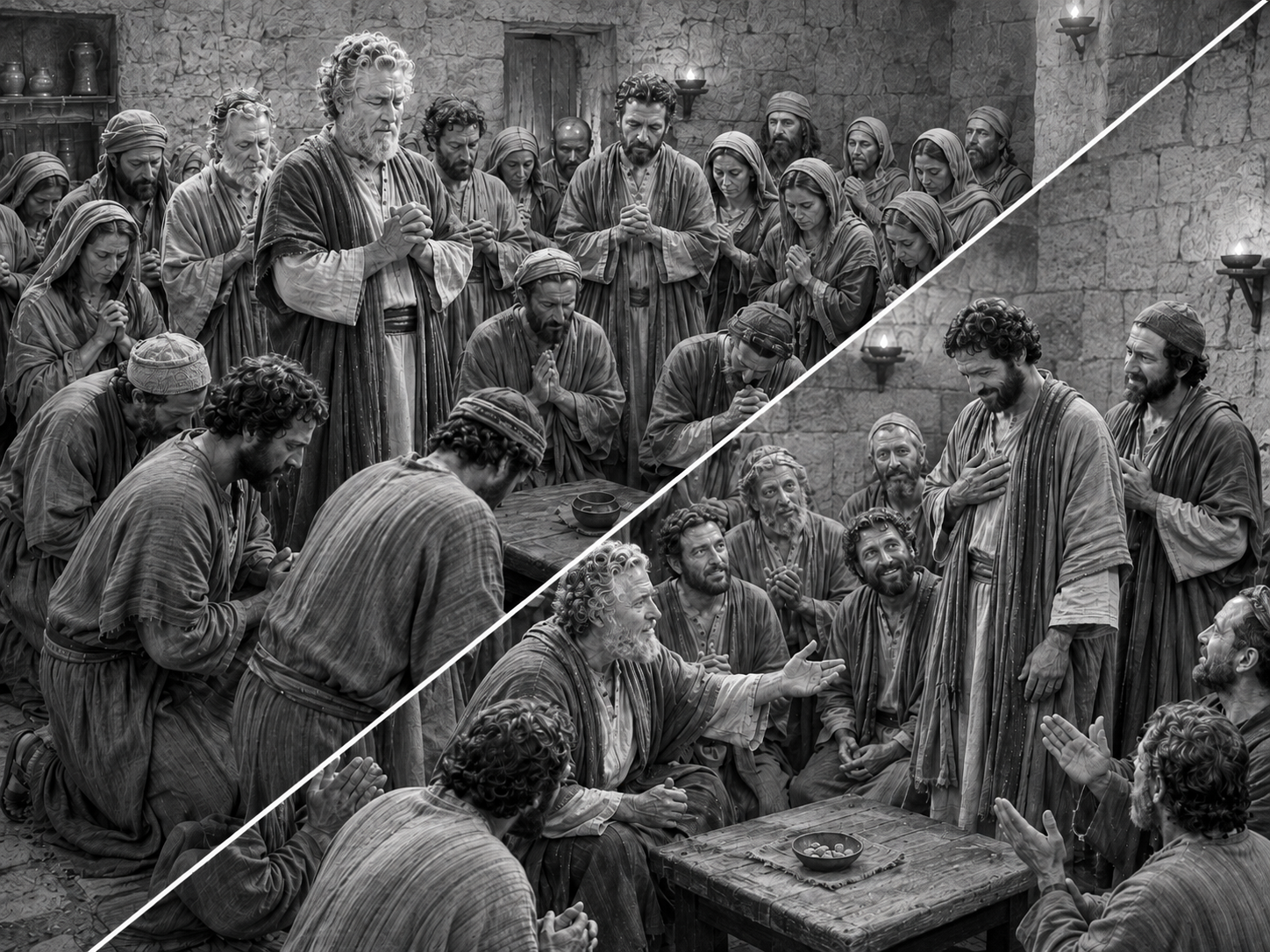
In a small schoolhouse in the 1850s, a stone building tucked away in the hills of Northern Ireland, four young men began meeting every Friday night to pray. There were no crowds, no musicians, no fanfare. They were just hungry for God’s Spirit to move in their land.
They did this for months, and for months nothing happened. They confessed sin, pleaded for mercy, praised God for His promises, and expressed longing for the Spirit to awaken the church in Ireland. Finally, in early 1859, the heavens opened. What started as four men on their knees led to 100,000 conversions to Christ within about a year. Churches overflowed with new converts; families gathered once again around God’s Word in homes; and civil crime was reduced to a trickle.
Virtually every true revival in church history has begun with prayer: not with worldly-wise prescriptions for what God should do around us but with earnest prayer for what God could do through us when we’re prepared for the moving of the Spirit of God.
And that’s what we see among the disciples in Acts 1:12–26. Before Pentecost’s power came in chapter 2, they were a people preparing themselves for the promised outpouring of God’s Spirit.
I’m titling this message: “Before the Fire Fell: How the Church Prepared for Pentecost.”
Context of Acts 1
Acts 1 bridges two worlds, the ministry of Jesus and the mission of His church.
Our text spans about 10 days. The math is pretty simple. Jesus was resurrected the Sunday morning after Passover week. Luke says Jesus ministered to them for the 40 days following his resurrection (1:3). Pentecost was always 50 days after Passover in the Jewish calendar. So, they’re waiting about 10 days for the outpouring of God’s Spirit during the Feast of Pentecost.
Let’s remember how Luke’s Gospel ends:
Luke 24:49: Jesus says,
“Behold, I am sending the promise of my Father upon you. But stay in the city [of Jerusalem] until you are clothed with power from on high.”
Then Jesus ascended out of their sight.
Luke 24:52–53:
“And they worshiped him and returned to Jerusalem with great joy, and were continually in the temple blessing God.”
Our text zooms in on those 10 days of waiting and shows how the church was preparing herself for Pentecost during those 10 days.
1. The Disciples Were Gathered in Prayer (vv. 12–14)
12 Then they returned to Jerusalem from the mount called Olivet, which is near Jerusalem, a Sabbath day’s journey away. 13 And when they had entered, they went up to the upper room, where they were staying, Peter and John and James and Andrew, Philip and Thomas, Bartholomew and Matthew, James the son of Alphaeus and Simon the Zealot and Judas the son of James [not Judas Iscariot]. 14 All these with one accord were devoting themselves to prayer, together with the women and Mary the mother of Jesus, and his brothers.
The Church United in Prayer
They obeyed Jesus’ command to return to Jerusalem. “The upper room” (v. 13) likely refers to the same “large upper room” where Jesus and his apostles ate the Passover meal together in Luke 22.
Luke here lists the names of only 11 apostles. We know Judas had already committed suicide after betraying Jesus. This core group includes the Eleven, “the women,” and Jesus’ own family, once skeptical but now believing.
Most vital to this first section is v. 14: “All these with one accord were devoting themselves to prayer.” The Greek word, homothymadon, “with one accord,” signals intense unity of purpose, emotion, and action, not just outward agreement.
Homo means “same.” Thymos means “passion, impulse, inner desire, emotional drive.” They were unified with a shared passion in prayer.
Prayer Precedes Power
Throughout Acts, we see this pattern: prayer precedes power.
In Acts 4, the church prays, and the place shakes, and they’re given boldness. In Acts 6, the church prays, and the Spirit leads in appointing leaders. In Acts 12, the church prays, and an angel frees Peter from prison and death. In Acts 13, the church prays, and the Spirit sets Paul and Barnabas apart for missionary service.
Have we learned this pattern for ourselves? Our power will never exceed our prayers. Our power in mission, our power in marriage, parenting, patience in suffering, effectiveness in evangelism, joy in sorrow, the exercise of our spiritual gifts: prayer precedes power.
Two realities ensure this rule: (1) We need God, and prayer connects us to the work of the Spirit. (2) God is passionate about the glory due to His name, and if God regularly empowered us apart from prayer, we would think the power resides in ourselves.
Consider how Scripture bears out this pattern that prayer precedes power.
Psalm 50:15: “Call upon me in the day of trouble; I will deliver you, and you shall glorify me.”
John 14:13: “Whatever you ask in my name, this I will do, that the Father may be glorified in the Son.”
John 15:5: “I am the vine; you are the branches. Whoever abides in me and I in him, he it is that bears much fruit, for apart from me you can do nothing.”
2 Corinthians 4:7: “But we have this treasure in jars of clay, to show that the surpassing power belongs to God and not to us.”
James 4:2: “You do not have, because you do not ask.”
When God’s People Pray
If Acts 1 teaches us anything, it’s that prayer precedes power.
The Moravian Prayer Movement of 1727 began with 24 believers meeting for prayer in Herrnhut, Germany. A single prayer meeting became a century long, 24 hour prayer vigil, fueling global missions in Europe and beyond.
The Welsh Revival of 1904 was born in hidden prayer. Evan Roberts prayed nightly, “Bend the church, O Lord, and save the world.” And God answered. Within months, nearly 100,000 came to Christ. Roberts later said, “The church that kneels together cannot fall.”
The Hebrides Revival of the 1950s began with two elderly sisters, Peggy and Christine Smith, praying nightly for revival. God moved so powerfully that Duncan Campbell wrote, “The atmosphere was so charged with the presence of God that one felt one could reach out and grasp that which surrounded us.” Powerful moves of God virtually always begin in “upper rooms” where God’s people gather in desperate, passionate prayer.
A culture of prayer in the church is like a symphony tuning its instruments to the same key and thus to each other before the concert begins. So, we find the early church “with one accord” tuning their hearts to heaven’s key before the Spirit brings the power at Pentecost.
Preparing Through Prayer
Do you depend more on planning than praying in your home and mission? Or do you trust strategy more than supplication?
Do we treat corporate prayer as our church’s engine or just an optional ornament?
Do we make major decisions with intense prayer, letting the Spirit align our vision with God’s work before moving?
Do we measure success by busyness rather than by seeing God work through us?
God can do more in five minutes than all of us put together could do in a lifetime!
But waiting in prayer is only part of the preparation. As the disciples’ hearts were uniting in prayerful worship and petition, their minds needed to be anchored in His promises. Prayer unites, and Scripture grounds.
2. The Disciples Were Grounded in Promises (vv. 15–20)
15 In those days Peter stood up among the brothers (the company of persons was in all about 120) and said, 16 “Brothers, the Scripture had to be fulfilled, which the Holy Spirit spoke beforehand by the mouth of David concerning Judas, who became a guide to those who arrested Jesus. 17 For he was numbered among us and was allotted his share in this ministry.” 18 (Now this man acquired a field with the reward of his wickedness, and falling headlong he burst open in the middle and all his bowels gushed out. 19 And it became known to all the inhabitants of Jerusalem, so that the field was called in their own language Akeldama, that is, Field of Blood.) 20 “For it is written in the Book of Psalms, ‘May his camp become desolate, and let there be no one to dwell in it’; and ‘Let another take his office.’”
Scripture Reframes Judas’ Betrayal
We can only imagine the questions swirling in the minds of the disciples about Judas. To us, his very name means vice and betrayal: we speak of a “Judas kiss.” But to the disciples, he was one of them until he wasn’t.
Judas was that family friend you’ve camped out with, vacationed with. The friend you’ve had in your home scores of times. The one you’ve laughed with; wept with. He was as good a friend as many of us will ever experience in this life. But behind your back, he had become a human trafficker.
He sold his Rabbi for the price of a male slave. This reality lay heavy on the minds of the disciples.
Peter stood up in the midst of about “one hundred and twenty” of them, and he turned their hearts toward Scripture to reframe their experience: “
Brothers, the Scripture had to be fulfilled which the Holy Spirit spoke beforehand by the mouth of David concerning Judas” (v. 16).
Peter cites Psalm 69:25, “May his camp become desolate,” and Psalm 109:8, “Let another take his office.” Here, Peter models reading David’s laments typologically: what befell David’s enemies foreshadowed what befell Jesus’ betrayer.
Judas’s grisly end (1:18–19) is narrated soberly. Luke’s aim is theological, not merely historical. Scripture governed the church’s understanding of their moment in history.
The same Spirit who authored the Old Testament Scriptures now interpreted their present. In Luke, the risen Jesus had already taught them to read Scripture this way. Jesus says in Luke 24:44: “Everything written about me in the OT Scripture must be fulfilled.”
God Has No Plan B
The significance of this truth is immense: even Judas’ betrayal did not break God’s purposes.
Judas didn’t mess up God’s Plan A. Jesus’ resurrection was not Plan B. God doesn’t have a Plan B. The incarnation, the cross, the resurrection were Plan A.
When we are grounded in God’s promises, we won’t be paralyzed by disappointments and the twists and turns in our lives. We’ll be steadied by the sovereign storyline of God, confident that His Word both directs and makes sense of our lives.
Promises That Reframe Our Lives
Just think of a few principles and promises from Scripture that reframe our experiences.
The truth of Creation gives meaning to our lives and mission. We are not accidents of history. All human objectives must be read in alignment with God’s good designs for us and His mandates to us to reflect His glory in our work, our homes, and our worship.
The fall of Adam and Eve explains the brokenness we daily face. Evil and spiritual warfare are not random bad luck. Betrayal, disappointment, sin, they reveal the depth of human depravity and call us to sober trust in God our only Redeemer.
God’s Providence gives us confidence to face the future. Nothing can derail God’s sovereign plans. Even our darkest moments become instruments to advance His redemptive purposes, even as He judges the wicked and chastises His people for our sins.
The cross reframes every betrayal and every wound. No painful wound has the last word in our lives; Christ’s victory over sin, sorrow, and death has the last word.
Our hope for the future new creation reframes our present suffering and our mission. Our story does not end in sorrow but in resurrection, in restoration, in renewal. Every tear, every loss, every injustice will be more than answered in the glory to come.
God’s Word anchored the early church to reality, and it will do the same for us. To be a people readied for the Spirit’s power, we must be a people grounded in God’s promises.
Preparing for War
Now, we can “say” this all day long, but are we actually grounding ourselves in the promises of God on a regular basis, like Peter sought to ground the church in Acts 1?
We too often approach the Bible like we approach YouTube shorts or another form of entertainment. We open our Bibles half heartedly, looking for a momentary dopamine hit to make us feel better before we move on with our day.
We should instead approach God’s Word like memorizing war plans before we enter the battles of the day. We should read like our lives depend on God’s promises.
Let me get specific: Do you show up to church as if being briefed for a SWAT operation, a frontal assault on the kingdom of darkness, or like you’re going to the movies to see a show?
I love seeing people show up to church with a Bible and a notebook (or even an iPad or laptop). They mean business. They’re getting ready for war.
Suppose it was announced that next Sunday, a generous donor was going to give $1 million to a person who could find the $1 million of gold bars hidden somewhere in the city of Mason. And that a detailed verbal map would be described on Sunday morning. I guarantee you that most of us would bring our notebooks, ready to write down every detail.
But that’s not how most of us come to church most of the time.
Why are we so caught off guard by trials? Why do we so easily grow discouraged in our walk with the Lord? Why are we caught flat-footed in gospel conversations with unbelievers that we have not prepared to have?
Because we haven’t prepared for war.
We spend our limited free time frivolously: memorizing sports stats and not God’s promises. Meticulously planning our retirements and not becoming conversant in a biblical worldview on the things that matter most in life. We spend more time complaining about other people than praying for them. More time trying to change our circumstances than clinging to God’s promises.
Would you consider memorizing a lament psalm (e.g., Psalm 42) to ready yourself for the next tragedy that will strike your life?
Would you consider ransacking your Bible on a daily basis to prepare for conversations with your spouse, your children, and your unbelieving coworkers and neighbors?
If we’re not investing in learning real answers to real questions and objections about the faith, are we even ready for a conversation about Jesus with them?
The instructions of the apostle Paul to Timothy in 2 Timothy 2:15 are for each of us:
“Do your best to present yourself to God as one approved, a worker who has no need to be ashamed, rightly handling the word of truth.”
So, prayer unites our hearts and readies us for God’s power; God’s promises steady and prepare our minds. But there is one more step before the fire falls in chapter 2: divine order. God never fills what He has not first formed. Christ aligns His church for mission by guiding us with purpose.
3. The Disciples Were Guided by Purpose (vv. 21–26)
21 So one of the men who have accompanied us during all the time that the Lord Jesus went in and out among us, 22 beginning from the baptism of John until the day when he was taken up from us, one of these men must become with us a witness to his resurrection.” 23 And they put forward two, Joseph called Barsabbas, who was also called Justus, and Matthias. 24 And they prayed and said, “You, Lord, who know the hearts of all, show which one of these two you have chosen 25 to take the place in this ministry and apostleship from which Judas turned aside to go to his own place.” 26 And they cast lots for them, and the lot fell on Matthias, and he was numbered with the eleven apostles.
Restoring the Twelve
So far, we’ve seen the disciples preparing for Pentecost by praying and interpreting their circumstances through Scripture. Now, we see them stepping forward in accordance with God’s unfolding redemptive purposes for the church: choosing a new apostle to replace Judas.
Why was it important for the church to have 12 apostles? Was it really necessary? Is Luke just recording random history, or is there something at work here that is preparatory for the Spirit bringing the fire in Acts 2?
Peter outlines the criteria for replacing Judas in vv. 21–22: “One of the men who have accompanied us during all the time that the Lord Jesus went in and out among us, 22 beginning from the baptism of John until the day when he was taken up from us, one of these men must become with us a witness to his resurrection.”
Apostolic authority was rooted in eyewitness participation in the ministry of Jesus. Only two men among them, Joseph and Matthias, fit that description. The community then prayed in v. 24: “You, Lord, who know the hearts of all, show which one of these two you have chosen.”
Luke notes that they cast lots, and Matthias “was numbered with the eleven apostles.”
God’s Redemptive Order
The restoration of the 12 apostles signifies restored completeness in God’s redemptive program. The Twelve Apostles in the New Testament corresponded to the 12 tribes of Israel in the Old Testament. Matthew 19:28 (cf. Luke 22:30):
“Jesus said to them, ‘Truly, I say to you, in the new world, when the Son of Man will sit on his glorious throne, you who have followed me will also sit on twelve thrones, judging the twelve tribes of Israel.’”
What we have here is a reconstitution of the people of God.
Just as Jesus was the fulfillment of Israel as the true Son of God, so all who put their trust in Him become a part of the true people of God in every age.
This act of choosing a 12th apostle underscored that the church’s divine mission demanded acting in accordance with divine purpose. God is not haphazard with His church; He had ordered its precise structure before its sending. Ephesians 2:20:
“[The church is] built on the foundation of the apostles and prophets, Christ Jesus himself being the cornerstone.”
This is why the number 12 is significant. The restoration of the Twelve signals continuity with and conformity to God’s redemptive purposes all along.
We can see, then, in v. 15, that it’s no accident that the number of disciples is said to be “about 120,” which signifies a fullness (12 times 10) and a continuity of the church with God’s redemptive plan initiated in the Old Testament with Israel’s 12 tribes.
We see this divine pattern and continuity of purpose all the way at the end of the Bible, in Revelation 21:12–14, visualized in the city of the New Jerusalem, the centerpiece of the New Creation.
“12 It had a great, high wall, with twelve gates, and at the gates twelve angels, and on the gates the names of the twelve tribes of the sons of Israel were inscribed, 13 on the east three gates, on the north three gates, on the south three gates, and on the west three gates. 14 And the wall of the city had twelve foundations, and on them were the twelve names of the twelve apostles of the Lamb.”
These restored Twelve were the authenticated witnesses of Christ and the foundation upon which the Spirit builds Christ’s church.
Today, we can expect the power of the Spirit only as we build upon the same foundation as revealed in Scripture, in continuity with the Old and New Testaments. God’s purposes for His church, what we do and how we function, must not be based on your preferences and innovations or mine.
The corporate church, as the true Israel in Christ Jesus, was to move from Jerusalem to the ends of the earth, bearing witness to the life, death, resurrection, and present kingdom of our Lord.
Guidance Before and After Pentecost
The use of casting lots in v. 26 may seem foreign to us today, and for good reason. But in the Old Testament, lots were often used to discern divine choice (Prov. 16:33).
So, this passage marks a redemptive historical transition: guidance before Pentecost was external and providential; after Pentecost, it becomes internal and Spirit-led.
Acts 1:26 is the last recorded instance in the Bible of God’s people casting lots to discern His will.
Acts 13: “The Holy Spirit said, ‘Set apart for me Barnabas and Saul.’”
Acts 15: “It seemed good to the Holy Spirit and to us.”
Acts 16: The Spirit redirects the travel plans of Paul in a vision of a man of Macedonia calling out for Paul to help them.
Many Christians today make the mistake of acting like Old Testament believers rather than Spirit-filled New Testament believers.
Some lay out a “fleece” (like Gideon), asking God for a specific external sign to confirm a decision. Some cast a die or flip a coin, seeking a random outcome as divine direction. Others open their Bible at random and point to a verse for guidance.
But these are sub-Christian methods of discerning God’s will, since we have the Spirit today in full.
Bible Roulette
There’s the story of a man who needed clear direction from the Lord, so instead of praying and seeking counsel, he chose the “Bible roulette” method of discernment, the “open and point” method.
He closed his eyes, flipped open his Bible, and jabbed his finger on a random verse. When he opened his eyes, it landed on Matthew 27:5: “And throwing down the pieces of silver into the temple, Judas departed, and he went and hanged himself.”
Shocked, he thought, “That can’t be right.” So he quickly flipped through again, closed his eyes, and pointed to another verse. This time his finger landed on Luke 10:37: “Jesus said to him, ‘You go, and do likewise.’”
Panic set in. Still unwilling to give up on this method, he tried a third time, only to land on John 13:27: “What you are going to do, do quickly.”
Just as prayer precedes power, so formation precedes fullness. Before the fire falls in Acts 2, Christ sets His house in order according to His redemptive purposes for the church.
Following God’s Design
Do you pray often for your pastors to discern God’s will by His Word and Spirit, not by popular trends or techniques? As we evaluate church ministries, are we following Scripture’s pattern and priorities or simply offering consumeristic value for a consumeristic people? To follow the example of the early church, we must submit to God’s timing in seasons of waiting and restructuring. The Spirit restores order before He releases power.
Conclusion
We’ve seen that the 120 disciples, ordinary, uncertain, still grieving and still rejoicing, gathered in prayer, grounded in God’s promises, and guided by God’s purposes for the church. The stage is now set for Pentecost.
I close with the prayer that was on the lips of the church in our passage: “You, Lord, know the hearts of all.” This is still true. He knows your heart and mine today. And the pattern of preparation for the Spirit remains the same. Prayer still precedes power. Readiness still comes before revival.
Christ still calls His people back to the upper room, to prayerful dependence, to devotion to Scripture, to obedience to God’s designs for His church, a people prepared for the Fire of the Spirit to fall. ❖